Sunday, August 30, 2015

Dogwatch


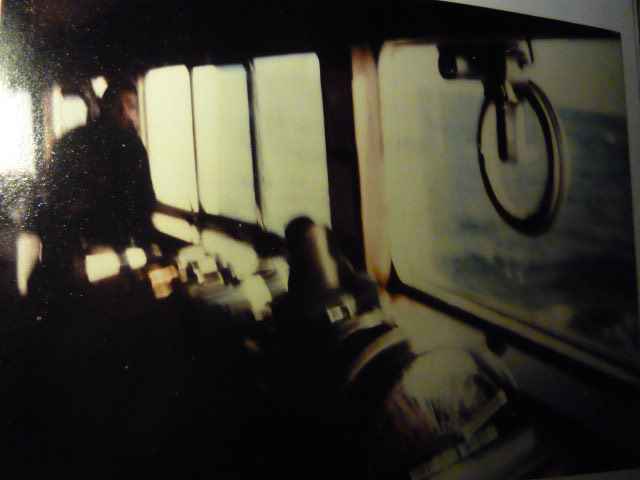
Running the Night watch, the 'dogwatch'


  Often my teacher Roxanne
would say that an illiterate man
doesn't differ from a log..

Proof that she was right
                        [is the fog,
my fog, which covers
                                  [all the knowledge
that others gain from having attended 
                         [an university or college.


A question from my ex-wife,

"have you learned
          [nothing from your life?"

I replied that I learned
                         [to read the sky
and to sleep with one open eye.


I learned the language
      [of the sun, moon and stars
like Jupiter, Sirius,
                      [Saturn and Mars,
that orient and guide me
                           [night and day.

I learned to work
       [every Sunday and holiday,
by running the 'dogwatch'*,
                     the predatory one...


I learned not to trust
                     [nothing and none
and always and everywhere
                           [to carry a gun.....

I forgot friends, parents, flirting and fun
and in hearing a suspicious noise, to 
                       [the lifeboats I would run.

These were my basic studies....
                            [and later, with continuous tours,
to broth@ls, I got my PhD* because of my study 
                                                              [on whores !


_____________________________________________________________


*Extract from "The Broken Mooring Line", an experiential
poetic work // page c52// e-mail: pmataragas@yahoo.com //
Texts and Narration: Odysseus Heavilayias - ROTTERDAM //
Language adjustments and text adaptation: Kellene G Safis - CHICAGO//
Digital adaptation and text editing: Cathy Rapakoulia Mataraga - PIRAEUS//

_______________________________________________________________


* Dogwatch The Oxford English Dictionary states that the word 'dogwatch' is a direct translation from either German or Dutch of a similar term. It originally referred to the night-watch on ships — that is, the time when (on land) all but the dog were asleep. The name is also said to be derived from Sirius, the "Dog Star", on the claim that Sirius was the first star that can be seen at night.

 * PhD - Doctorate is an academic or professional degree that, in most countries, qualifies the holder to teach at the university level in the degree's field, or to work in a specific profession. In some countries, the highest degree in a given field is called a terminal degree. Many universities award "honorary doctorates" to individuals who have been deemed worthy of special recognition, either for scholarly work or for other contributions to the university or to society.
The term "doctorate" derives from the
Latin docere meaning "to teach". The doctorate (Latin: doctor, "teacher," from doctum, "[that which is] taught," past participle of (docere), "to teach") appeared in medieval Europe as a license to teach Latin: (licentia docendi) at a medieval university. Its roots can be traced to the early church when the term "doctor" referred to the Apostles, church fathers, and other Christian authorities who taught and interpreted the Bible.


  the tales of a greek sailor  


Tuesday, August 11, 2015

My hate list


Sailor's Hate List.  

I hated........ my profession,
the reason......
  [for my chronic depression,
and the cause of my multi-annual slavery.

The reason for being forced to consort
                 [with characters often unsavory..


So over time I hated the sea,
the constant travel, and
                   [the constant flee.

I hated the wind and waves,
and my comrades,
         [the same as me slaves ....


If you could see my soul....
                                [it's full of scars,
I even hated the beautiful nights
                                    [and the stars.


I hated each port
with prostitutes in the bazaars
I hated to be a frequenter of
                      [brothels and bars....

Years passed and........
           [my retirement time had come.

Curiously, instead of glad I was glum
when the motorboat
               [was taking me off the ship.

I had a tear and a tremble in my lip
implying perhaps,
                        [some of my own guilt.

Just then I realized
             [that hatred and love coexist


and it was completely misleading
                                          [my hate list.


______________________________


*Extract from "The Broken Mooring Line", an experiential
poetic work // page c51// e-mail: pmataragas@yahoo.com //
Texts and Narration: Odysseus Heavilayias - ROTTERDAM //
Language adjustments and text adaptation: Kellene G Safis - CHICAGO//
Digital adaptation and text editing: Cathy Rapakoulia Mataraga - PIRAEUS//


  the tales of a greek sailor  


Sunday, August 2, 2015

Giants and Dwarves


Our vessel sailed the river Río de la Plata
and with a load of flour,
                            [headed towards Calcutta.

The Pacific Ocean denied its name

and with huge waves
      [that name managed to defame....


Poets and writers
                   [very often misled me,
so I became a prisoner of the sea...


      "Smell the sea,
                      [and feel the sky
      let your soul & spirit fly.."


Van Morrison
       [didn't mention the word cry,

the famous Van Morrison
                                    [in his song.


      Believe me, I am not wrong......

      Longfellow writes that "the heart of the ocean
      sends a thrilling pulse through me."


                                                         [so set in motion
      the imagination of young people and mine....


 After one month journey,
                                [an Albatross was the sign
   that..... we were approaching the shore.

   We, forty dwarves, maybe a little more,
   we the crew.....temporarily won
                            [against the Giant Ocean.


Ι shaved, put on my face after shave lotion
and together with my fellow sailors,
                      we went looking for hookers..


   The next day a bunch of Indian troopers
   came to guard the flour
                                  [and boarded the ship.

   While the Indian officer
                     [was drinking coffee sip by sip,
   he greeted me,
                        [saying hello Indo-European.

   Ι answered Hello dude,

                   but I am a Greek, a Mycenaean..
   I was born where the civilization was born.
   The Indo-European theory
                                           [died at the dawn
   of the decryption of the DNA,
   and after that ended
                the storytellers sway..

The result of this
                   [newly discovered analysis proves
59,000 years continuity of the Greeks
                                         [and lies disapproves...

___________________________________________________    
                               
*Extract from "The Broken Mooring Line", an experiential
poetic work // page c50// e-mail: pmataragas@yahoo.com //
Texts and Narration: Odysseus Heavilayias - ROTTERDAM //
Language adjustments and text adaptation: Kellene G Safis - CHICAGO//
Digital adaptation and text editing: Cathy Rapakoulia Mataraga - PIRAEUS//

_______________________________________________________________


Indo-Europeans, The second half of the 18th and early 19th century. developed by French Coeurdoux (1767), the Englishman William Jones (1786) and by the Germans Fr. Schlegex (1772-1829) and Fr. Bopp (1791-1867) theory of Indo-Europeans.

In theory people from India went to Europe and the 3rd BC millennium arrived in the Ural Mountains and others went to the D. Europe and others since 2000 BC They began to descend to the southern part of the Balkan peninsula as Ionians in 1800 BC as Achaeans and 1100 BC as Dorians.
Later it was seen as the cradle of Indo-European peoples or Iapetus (including other than Europeans and Indians and Armenians, Persians and Afghans) The northern or central Europe and others went east to India and others through the valley of Axios until Greece . That's why there are common words.
Indo-European theory reject recent research of DNA, made by universities in Europe and America, in which he participated and the Aristotle University of Thessaloniki, and had the aim to investigate the biological roots of European populations.
Investigations have shown that the Greeks by 75-80% have Paleolithic origin to 80,000 years ago and by 20-25% Neolithic 9000-3000 BC.


  the tales of a greek sailor  


Monday, July 27, 2015

She was considered the most beautiful woman in the world


                  ...but for her they never shot an arrow

As a seafarer who has navigated all the seas and oceans,
I lived strange experiences and strong emotions.

Those thirty years I saw and heard incredible things,
but a story of them, semicolons, questions and doubts brings...


Once while I was sailing along the coast of ancient Troy,
inevitably I was thinking of the Homeric Trojan campaign to destroy
the one who had control of narrow*.                                   

My poor Helen, for you they never shot an arrow...

The Trojans were holding the keys to the Black Sea
and the Greeks were tired of paying the fee....


The old stoker, suddenly interrupted my thoughts,
and together we broke into history's unknown slots.

He told me...I'm a Trojan, and my ancestors 
                                                 [came back to the region,
along with Constantine the Great and the 
                                                             [first Roman legion.                   
Aeneas fleeing Troy.......   to Latium
Eight miles away from Troy is Dardanos,                                                                   [my hometown.
After the fall of Troy, Aeneas would not                                                                            [bow down                                                    
and he sailed from my city along with                                                           [other Trojan fighters.... 


They went to Italy as mentioned by Virgil   
                                             [and many writers.

There, they defeated the Latins and 
                                           [created an empire,
so large that without refueling today 
                      [you could not cross in an airliner...

These descendants of Aeneas and the
                                                                [Trojans
became masters of the world, and called 
                                                              [Romans..

They never forgot Troy though thousands 
                                                             [of years passed,
with plans to return home with armies they massed....

The return trip was made in 330 AD..

In order not to be forced, as in the Trojan war, to flee,
they founded the capital of they empire in Byzantium, a fortified position,
several miles farther from Troy, as the base of each expedition....

In Byzantium the people were speaking Greek

and over the years each Roman Greek will speak.....
Finishing the old man, the stoker, said:

                 EPILOG

When I was born.....
Greek was the language of my bred..


Am I...    A Trojan?               
                A Roman? 
                A Greek?
                A Hellen?

Two mysteries of history, I and queen of Sparta, Helen ...


___________* *___________


*Hellen, in Greek mythology, king of Phthia was the eponymous ancestor of all true Greeks, called Hellenes in his honour.

The Hellenes consisted of the Aeolians, Dorians, Ionians, and Achaeans, traditionally descended from and named for Hellen’s sons, Aeolus and Dorus, and his grandsons (by his third son, Xuthus), Ion and Achaeus.
______________________________________________________


Texts and Narration: Odysseus Heavilayias - ROTTERDAM //
Language adjustments and text adaptation: Kellene G Safis - CHICAGO//
Digital adaptation and text editing: Cathy Rapakoulia Mataraga - PIRAEUS//
Νο: 49
                                              _________________


*Helen of Troy, In Greek mythology, Helen of Troy (Greek Ἑλένη Helénē, pronounced [helénɛː]), also known as Helen of Sparta, was the daughter of Zeus and Leda, and was a sister of Castor, Pollux, and Clytemnestra. In Greek myths, she was considered the most beautiful woman in the world. By marriage she was Queen of Laconia, a province within Homeric Greece, the wife of King Menelaus. Her abduction by Paris, Prince of Troy, brought about the Trojan War. Elements of her putative biography come from classical authors such as Aristophanes, Cicero, Euripides and Homer (both The Iliad and The Odyssey).

*Dardanos : Eight miles to the ancient city of Troy.

*Constantine the Great,   57th Emperor of the Roman Empire


Colossal marble head of Emperor
Constantine the Great, Roman, 4th century
Constantine the Great (Latin: Flavius Valerius Aurelius Constantinus Augustus; Greek: Κωνσταντίνος ὁ Μέγας; 27 February c. 272 AD – 22 May 337 AD), also known as Constantine I or Saint Constantine (in the Orthodox Church as Saint Constantine the Great, Equal-to-the-Apostles), was a Roman Emperor from 306 to 337 AD of Thracian-Illyrian ancestry. Constantine was the son of Flavius Valerius Constantius, a Roman army officer, and his consort Helena. His father became Caesar, the deputy emperor in the west in 293 AD. Constantine was sent east, where he rose through the ranks to become a military tribune under the emperors Diocletian and Galerius. In 305, Constantius was raised to the rank of Augustus, senior western emperor, and Constantine was recalled west to campaign under his father in Britannia. Acclaimed as emperor by the army at Eboracum (Modern-day York) after his father's death in 306 AD, Constantine emerged victorious in a series of civil wars against the emperors Maxentius and Licinius to become sole ruler of both west and east by 324 AD.

As emperor, Constantine enacted many administrative, financial, social, and military reforms to strengthen the empire. The government was restructured and civil and military authority separated. A new gold coin, the solidus, was introduced to combat inflation. It would become the standard for Byzantine and European currencies for more than a thousand years. The first Roman emperor to claim conversion to Christianity,[notes 4] Constantine played an influential role in the proclamation of the Edict of Milan, which decreed tolerance for Christianity in the empire. He called the First Council of Nicaea in 325, at which the Nicene Creed was professed by Christians. In military matters, the Roman army was reorganised to consist of mobile field units and garrison soldiers capable of countering internal threats and barbarian invasions. Constantine pursued successful campaigns against the tribes on the Roman frontiers—the Franks, the Alamanni, the Goths, and the Sarmatians—even resettling territories abandoned by his predecessors during the turmoil of the previous century.

The age of Constantine marked a distinct epoch in the history of the Roman Empire. He built a new imperial residence at Byzantium and renamed the city Constantinople after himself (the laudatory epithet of "New Rome" came later, and was never an official title). It would later become the capital of the Empire for over one thousand years; for which reason the later Eastern Empire would come to be known as the Byzantine Empire. His more immediate political legacy was that, in leaving the empire to his sons, he replaced Diocletian's tetrarchy with the principle of dynastic succession. His reputation flourished during the lifetime of his children and centuries after his reign. The medieval church upheld him as a paragon of virtue while secular rulers invoked him as a prototype, a point of reference, and the symbol of imperial legitimacy and identity. Beginning with the Renaissance, there were more critical appraisals of his reign due to the rediscovery of anti-Constantinian sources. Critics portrayed him as a despotic tyrant. Trends in modern and recent scholarship attempted to balance the extremes of previous scholarship.

Constantine—as the first Christian emperor—is a significant figure in the history of Christianity. The Church of the Holy Sepulchre, built on his orders at the purported site of Jesus' tomb in Jerusalem, became the holiest place in Christendom. The Papal claim to temporal power was based on the supposed Donation of Constantine. He is venerated as a saint by Eastern Orthodox Christians, Byzantine Catholics, and Anglicans.


  the tales of a greek sailor  

Wednesday, July 22, 2015

When I traced the routes of....


                   ...the Explorers

     In the forecastle
              [of the Liberty* "Greek Pine"          
        holding a thin rope,
                                  [a heaving line*
        I had a certain strange feeling.
Holding a heaving line
        It would be better said,
                       [a thought appealing...
        It would be better said,
                             [strange rationale....

        Our ship was sailing into the 
                                 [Panama canal,
        in the westerly direction
        and this was the cause
                  [of the connection
        between me.....
                    and the Explorer....

        Panama was the origin
                        [of our restorer
        and when we arrived in the canal,
        I said to him...
            ''tell me about your country pal''.

        He willingly talked to me about it all.

        When he mentioned
                     [Vasco De Balboa*,
        I heard weeping from Raul,
        because that was also the name of his mother..
        He said to me
       "they both belonged to the same family, brother.

                         _________ * * __________


        In a few hours it was my turn
                                        [to be emotionally moved.

        I traveled many years
                                      [and I never was unmoved
        when I traced the routes
                                       [of the past explorers,
        when I was trailing traces
                                      [of those old seafarers,
        in a way I was living mentally in their time.

        In Panama,
                      I followed Balboa, but the regime,
        as I was informed
                               [had executed him long ago.

        In the Pacific I followed Magellan, but woe
        the warriors of Lapu-Lapu* killed him in battle.            

        In the Atlantic I followed Columbus.....
                                        [and a sailor from Seattle
        told me that the explorer is in prison in Spain.
        In my short story (in the history of the world).... 
                                                            [a third stain ...
______________________________________________


*Extract from "The Broken Mooring Line", an experiential
poetic work // c48// e-mail: pmataragas@yahoo.com //
Texts and Narration: Odysseus Heavilayias - ROTTERDAM //
Language adjustments and text adaptation: Kellene G Safis - CHICAGO//
Digital adaptation and text editing: Cathy Rapakoulia Mataraga - PIRAEUS//
_______________________________________________________________


1. The Liberty ship was a class of cargo ship built in the United States during 
World War II.
SS John W. Brown on the Great Lakes in 2000. John W. Brown is one of only two surviving World War II Liberty Ships, the other being the SS Jeremiah O'Brien.


2. Heaving line (nautical term) : A rope with a heavy knot on the end light enough for a seaman to throw to a dock or another vessel. The bitter end of the heaving line is secured to the end of a heavier dockline or towing line so that it can then be hauled over


3. Lapu-Lapu (fl. 1521) was a ruler of Mactan in the Visayas. The Philippines regards him as the first Filipino hero because he was the first native to resist Spanish colonization through his victory over the explorer Ferdinand Magellan. Monuments of Lapu-Lapu have been built in Manila and Cebu while the Philippine National Police and the Bureau of Fire Protection use his image in his honor.

He is best known for the Battle of Mactan, which happened at dawn on April 27, 1521. The battle halted the Magellan expedition and delayed Spanish occupation of the islands by over forty years until the expedition of Miguel López de Legazpi in 1564.

Besides being a rival of Rajah Humabon of Cebu, little is known about the life of Lapu-Lapu and the only existing documents about his life are those written by Antonio Pigafetta. His name, origins, religion, and fate are still a matter of controversy.


The Battle of Mactan (Cebuano: Gubat sa Mactan; Filipino: Labanan sa Mactan; Spanish: Batalla de Mactán) was fought in the Philippines on 27 April 1521, prior to Spanish colonization. The warriors of Lapu-Lapu, a native chieftain of Mactan Island, defeated Spanish forces under the command of Ferdinand Magellan, who was killed in the battle.


4. Vasco Núñez de Balboa: The 16th-century Spanish conquistador and explorer Vasco Núñez de Balboa (1475-1519) helped establish the first stable settlement on the South American continent at Darién, on the coast of the Isthmus of Panama. In 1513, while leading an expedition in search of gold, he sighted the Pacific Ocean. Balboa claimed the ocean and all of its shores for Spain, opening the way for later Spanish exploration and conquest along the western coast of South America. Balboa’s achievement and ambition posed a threat to Pedro Arias Dávila, the Spanish governor of Darién, who falsely accused him of treason and had him executed in early 1519.


  the tales of a greek sailor  

Saturday, July 11, 2015

“Get The F.... Out of My Way


                Botany Bay* Mooring*

After successive wild seas and gales
we reached Sydney, the state capital of New South Wales,
the port we used to call "The cat o' nine tails".
I'll tell you why but I will not go into details.
Grueling and long working hours to hold 
                                            [the ship in place.


We were already exhausted and please note 
                                               [the strange case.
________________________________________________________


A MONTH EARLIER  (70's, the era of disco),
after drunkenness, our ship departed from 
                                               ["Little San Francisco,
(so, Vakparaizo in Chile, call the sailors).


The Pacific greeted us with consecutive hailers
and with unprecedented huge waves.

"Chief Engineer strangely behaves"
donkeyman* said with concern to me,
and he was right......
                  in two hours the ship was wayward in the sea
and the engineer was saying that engine was out of order..


It looked like generalized anxiety disorder
displayed by the engineers when every attempt failed..

We need much luck to live, the terrified Captain revealed,
while others were crying and others were praying,

Suddenly everyone saw the old former fisherman 
                                                              [running and saying...
"I got it, the engineers are idiots, the cause is the filter
and by saying to Chief engineer 
                                 ["get the hell out of my way, mister",
he went and washed the filter from the engine of the ship.


Thanks to him, we were saved and continued our trip.

The former fisherman was not a magician,
but in his boat was the captain, the engineer and the technician.
____________________________________________________


The story should end here, and with it, a happy ending
but when my microwave hood brown down and said 
                                       [the technician there is no mending,

I pointed out to him to clean the filter
and the microwave hood worked...... Τhe guy said 
                                             ''how did you know this mister?''
___________________________________________________


*Extract from "The Broken Mooring Line", an experiential
poetic work // c47// e-mail: pmataragas@yahoo.com //
Texts and Narration: Odysseus Heavilayias - ROTTERDAM //
Language adjustments and text adaptation: Kellene G Safis - CHICAGO//
Digital adaptation and text editing: Cathy Rapakoulia Mataraga - PIRAEUS//

_______________________________________________________________


*Mooring,   The act of making fast a vessel.


*Botany Bay, Australia,    An open oceanic embayment, is located in Sydney, New South Wales, Australia, 13 km (8 mi) south of the Sydney central business district
Lieutenant James Cook first landed at Kurnell, on the southern banks of Botany Bay, on Saturday 29 April 1770, when navigating his way up the east coast of Australia on his ship, HMS Endeavour. Cook's landing marked the beginning of Britain's interest in Australia and in the eventual colonisation of this new ‘southern continent’. Initially the name Sting Ray Harbour was used by Cook and other journal keepers on his expedition, for the stingrays they caught. That name was also recorded on an Admiralty chart. Cook's log for 6 May 1770 records "The great quantity of these sort of fish found in this place occasioned my giving it the name of Stingrays Harbour". However, in the journal prepared later from his log, Cook wrote instead:(sic) "The great quantity of plants Mr. Banks and Dr. Solander found in this place occasioned my giving it the name of BotanistBotany Bay".


*Donkeyman,  (nautical) The person in charge of a ship's engine room.


*Distances,  Puerto Valparaiso, Chile to Port of Sydney , Australia, 12869 nautical miles.


*Valparaíso,  played an important geopolitical role in the second half of the 19th century, when the city served as a major stopover for ships traveling between the Atlantic and Pacific oceans by crossing the Straits of Magellan. Valparaíso mushroomed during its golden age, as a magnet for European immigrants, when the city was known by international sailors as "Little San Francisco" and "The Jewel of the Pacific". In 2003, the historic quarter of Valparaíso was declared a United Nations Educational, Scientific, and Cultural Organization (UNESCO) World HeritageSite.


*Sydney,  is the most populous city in Australia and Oceania. Located on Australia's east coast, the metropolis surrounds the world's largest natural harbour, and sprawls towards the Blue Mountains to the west.Residents of Sydney are known as "Sydneysiders".


*The cat o' nine tails, commonly shortened to the cat, is a type of multi-tailed whip that originated as an implement for severe physical punishment, notably in the Royal Navy and Army of the United Kingdom, and also as a judicial punishment in Britain and some other countries.


*Disco music,  was a worldwide phenomenon, but its popularity declined in the United States in the late 1970s. On July 12, 1979, an anti-disco protest in Chicago called "Disco Demolition Night" had shown that an angry backlash against disco and its culture had emerged in the United States.


  the tales of a greek sailor